
i have no willpower · 9 min read
“I have no willpower”: why that is almost never the problem

If you have tried to look after yourself many times and always given up, the problem most likely was not your willpower but the plan: almost all of them are built to last weeks, not years. One that only holds up while you grit your teeth is badly designed: nobody grits their teeth for two years.
I have been a nurse for more than fourteen years and I have heard «the thing is, I have no willpower» hundreds of times. It is almost always said by someone who has proved the opposite: they have raised children, worked shifts, got harder things done than giving up bread.
Why do I always give up after three weeks?
Because what you abandon is almost never the goal: it is the method.
In what I see, two or three weeks is what enthusiasm alone will carry: a diet that takes away everything you like and training that leaves you wrecked. After that, no.
It is not a failure of character: it happens to anyone, and the odd thing would be the opposite.
And there is a trap almost nobody mentions: guilt. One slip breaks nothing — one meal does not move an HbA1c — but «well, I have ruined it now, what does it matter» does: it turns one meal into three weeks.
What breaks a process is not the slip, it is what you tell yourself after the slip. That is why the plan has to survive bad days: if it only works when everything goes well, it does not work.
So what actually goes wrong?
In what I see, it is almost always one of these four. None of them has anything to do with wanting it enough:
- The plan did not fit your life. Your hours, your job, who cooks at home. If it forces you to cook separately, it lasts as long as the rest of the household’s patience.
- Nobody watching. With no one to tell your week to, the bad week turns into the bad month without anyone noticing, you least of all.
- You were chasing the result, not the process. If only the scales count, two flat weeks — completely normal — look like failure, and that is where people give up.
- Everything at once, from day one. Cut out bread, join a gym and sleep eight hours, starting Monday.
Changing five things at once is the most reliable way of changing none of them.
Is this happening to you?
If you have been trying for a while and the number will not move, tell me. The first conversation is free and carries no commitment.
First call free · No commitment
And what if it does not work for me this time either?
It is the most honest question, and the one I am asked most. I will not tell you it is impossible, but there are three things I can stand behind.
If I think I cannot help you, I will tell you in the first conversation and that is the end of it. I would rather not take you on than take you on and have you drop out in three weeks.
3 monthsis how long HbA1c takes to reflect a new life: by around the third month there is a blood test that can prove you right. It is not a promise.
And there are things that do not depend on either of us: I will tell you those too.

What almost everybody thinks before calling
These sentences have been said to me so many times that I have them written down. If you have thought any of them, you are not odd: you are the norm.
«I have no time to look after myself»
That is usually true, and it is why the plan is built on your real hours, not on ideal ones: training at home in under half an hour, and food made from what is already cooked in your house. If a plan needs you to have spare time, it is badly made: nobody has spare time.
«I cannot see myself sticking to a plan, I always give up»
It is one of the things I am told most, and it is almost always said by someone who has already proved the opposite. That is why the first phase, DESPEGA, only aims to get you seeing something move early on, not to get you doing everything right.
«It will be a strict diet and I will not be able to eat what I like»
There are no banned foods, and that is not a slogan: bans are exactly what makes people give up. We work on the order of the dishes, the shape of the carbohydrate and the protein in each meal, which move blood sugar without taking anything away from you.
«The training will frighten me, or it will be too hard»
It starts very gently on purpose, at home and with no previous experience. Fernando started at 65; today, at 68, he plays golf with heavier clubs because he is stronger. The training is planned and reviewed by the team’s trainers, not by a generic video.
«The public health service already monitors me» · «I already know what I have to do»
Both are usually true, and neither is beside the point. I work inside the system and I admire most of the people in it, but ten minutes of consultation is not enough to teach you how to eat and how to train. And as for what to do, almost everybody knows: what is usually missing is a plan that holds up and someone watching.
«It is expensive»
I do not put the price on the website, and it is not to hide it: the support is not the same for prediabetes just picked up as it is for someone eight years into medication. I explain it in full in the first conversation, which is free, before you decide anything.
And if none of this has convinced you
That is fine. There is one thing you can do today without talking to me and without leaving me your email: understand what your last blood test says. If you want to tell me about it afterwards, I am here.
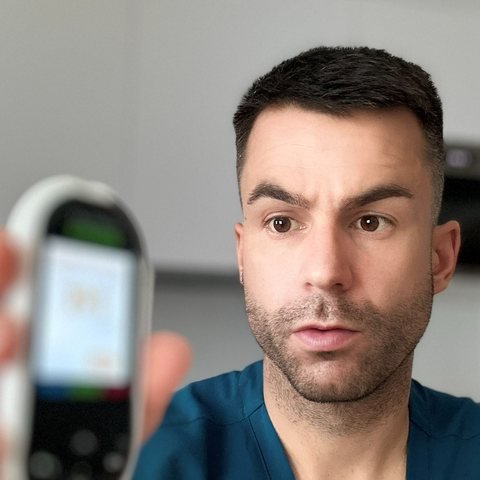
Pablo Berna Sierra · Nurse, dietitian and trainer
Nursing registration no. 15794 · Colegio Oficial de Enfermería de Zaragoza
Over 14 years practising as a nurse and over a decade working with people with type 2 diabetes, prediabetes and excess weight. More about me.
Sources
1
- Dickinson JK et al. «The Use of Language in Diabetes Care and Education». Diabetes Care, 2017. The ADA and ADCES consensus: language that blames the person can affect how they live with their diabetes and how they look after themselves. View source
Please note. This article is for general guidance and does not replace consultation with your doctor or the treatment prescribed to you. Do not change your medication on your own.